From Frantic Control to Active Dependence: A Christian Woman’s Guide to Finding Peace
🎧 Prefer to listen instead of read? Press play below. You can listen while driving, cleaning, walking, or during quiet time.

1. Introduction: The Soul in a State of Acceleration
Modern life moves at a pace your soul was never intended to endure. You likely know the feeling of "inner acceleration"—that humming motor of anxiety that runs beneath the surface of your day. It is a quiet exhaustion born from the weight of home responsibilities, workplace pressures, and the emotional fatigue of holding a family together. You may find yourself oscillating between the exhaustion of trying to fix everything and the paralysis of wanting to hide from it all.
When the pressure rises, we often default to "frantic control"—overmanaging, overthinking, and trying to force certainty. Or, we slide into avoidance, numbing our minds and calling it "trust." Neither of these paths is the way of the Master. Jesus did not speak to people with easy lives; He spoke to those facing grief and confusion when He said:
“Let not your heart be troubled: ye believe in God, believe also in me.” (John 14:1, KJV)
The path to peace is found in "Active Dependence." This is the middle ground where you are neither frozen in passivity nor frantic in effort. It begins with the realization that stillness is not an escape from reality; it is a surrender to the One who rules it.
2. The Great Divide: Your Part vs. God’s Part
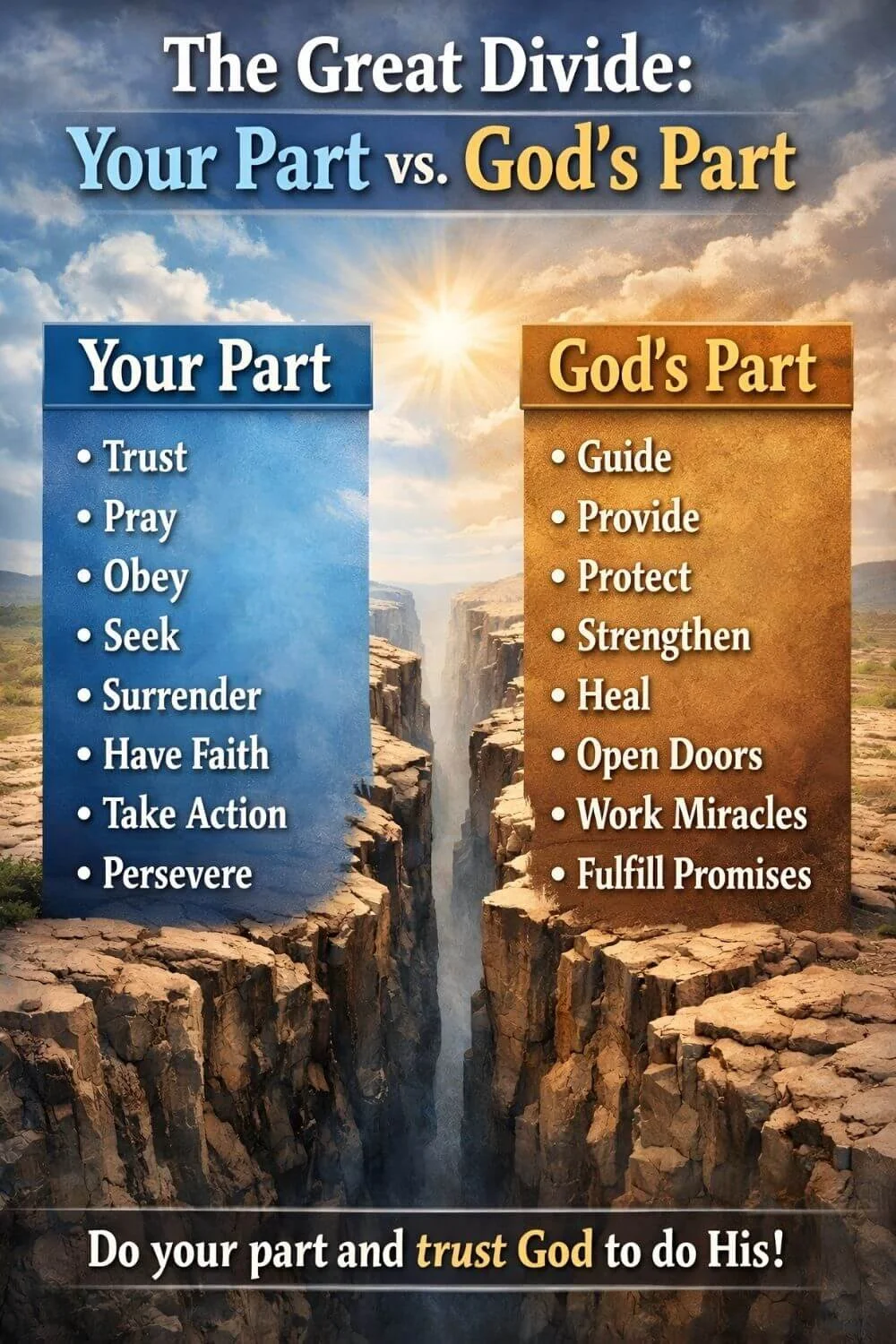
Anxiety grows most rapidly when we attempt to take on "God’s part"—the sovereign control over outcomes we cannot command. To find stability, you must distinguish between your faithful obedience in the present and God’s sovereign control over the future.
Think of King Jehoshaphat when he was surrounded by a great multitude. He did not pretend the danger wasn’t real, but he identified his limits clearly:
“O our God... neither know we what to do: but our eyes are upon thee.” (2 Chronicles 20:12, KJV)
Biblical trust is being faithful with what is clear while God is faithful with what is hidden. You are responsible for the effort; He is responsible for the results.
The Division of Responsibility
Your Part (Faithful Responsibility)
God's Part (Sustaining and Outcomes)
Taking the Next Step: Moving forward and "doing good" (Psalm 37:3) despite uncertainty.
The Final Outcome: Managing the results and managing the future of all situations.
Honest Communication: "Pouring out your heart" (Psalm 62:8) and naming specific fears.
Sustaining the Soul: Holding you when you are weary and providing "daily bread."
Renewing the Mind: Disciplining your attention to focus on God's unchanging character.
Directing the Path: Seeing the end from the beginning and guiding your steps.
Honoring Limits: Accepting your human boundaries as a "creature" through rest.
Providing Peace: Granting the gift that guards your heart and mind (Philippians 4:7).
3. Biblical Reframing: Turning "Fearful Conclusions" into Truth

Anxious thoughts rarely present themselves as suggestions; they masquerade as undeniable facts. However, these thoughts are often merely "fearful conclusions" about things that haven’t happened. To counter this, you must practice "disciplined attention"—a holy interruption of the inner acceleration.
Reframing is not shallow positivity; it is a call to truth-telling. When a fearful conclusion enters your mind, you must expose it and replace it with the reality of God’s character:
Anxious Thought: "Everything depends on me."
Biblical Reframe:God is sovereign. (Proverbs 3:5-6)
Anxious Thought: "If I fail here, everything falls apart."
Biblical Reframe:His grace is sufficient. (2 Corinthians 12:9)
Anxious Thought: "God will not come through for me this time."
Biblical Reframe:The Lord is faithful. (Lamentations 3:23)
4. The Framework for the Moment: The "Holy Pause"

Anxiety moves fast, often causing your body to react before your mind can process the trigger. To slow the storm, use this six-step framework to respond in real-time. Do not wait for the feeling of peace to arrive before you act; peace often grows while we obey, not before.
Notice: Recognize the physical signals—the racing heart or the tight chest—that indicate an inward storm is beginning.
Name: Identify the specific fear. Move from a vague sense of dread to naming the concern: "I am afraid of this financial shortfall" or "I am worried about my child's struggle."
Pray: Speak plainly to God. This is prayer as a release of a burden, not a performance. "Lord, I am tired of carrying this uncertainty."
Reframe: Challenge the specific fear with a biblical truth about God’s character.
Entrust: Intentionally hand the final outcome back to God. Refuse to "play God" by trying to force a specific result.
Act: Take the next faithful step even if you feel "shaky." Send that message, keep that appointment, or have that hard conversation.
By acting in "shaky obedience," you demonstrate that fear does not decide your next step. You can find the "settled nearness" described in the Psalms:
“Surely I have behaved and quieted myself, as a child that is weaned of his mother: my soul is even as a weaned child.” (Psalm 131:2, KJV)
5. Establishing Spiritual Rhythms: Morning, Midday, and Night

Peace is rarely accidental; it is cultivated through repeated habits that draw the soul back to God. A "Daily Rule of Trust" establishes a rhythm of return.
Morning: Begin with a Psalm and a prayer of surrender. Before the world asks anything of you, acknowledge that God is the Sustainer.
Midday: Use the "Holy Pause" to interrupt the momentum of stress. A thirty-second whisper of Scripture can reorient a heart that has begun to race.
Evening: Name specific anxieties to God before sleep. Lay them at His feet so you do not have to carry them into your dreams.
Honoring Your Limits
A vital part of your spiritual formation is accepting that you are a creature, not the Creator. You have limits. Sleep is not a sign of failure; it is a confession of faith. It is your way of saying, "God remains faithful even when I stop working."
“It is vain for you to rise up early, to sit up late, to eat the bread of sorrows: for so he giveth his beloved sleep.” (Psalm 127:2, KJV)
6. Navigating the Hardest Seasons: Silence, Suffering, and Secrecy
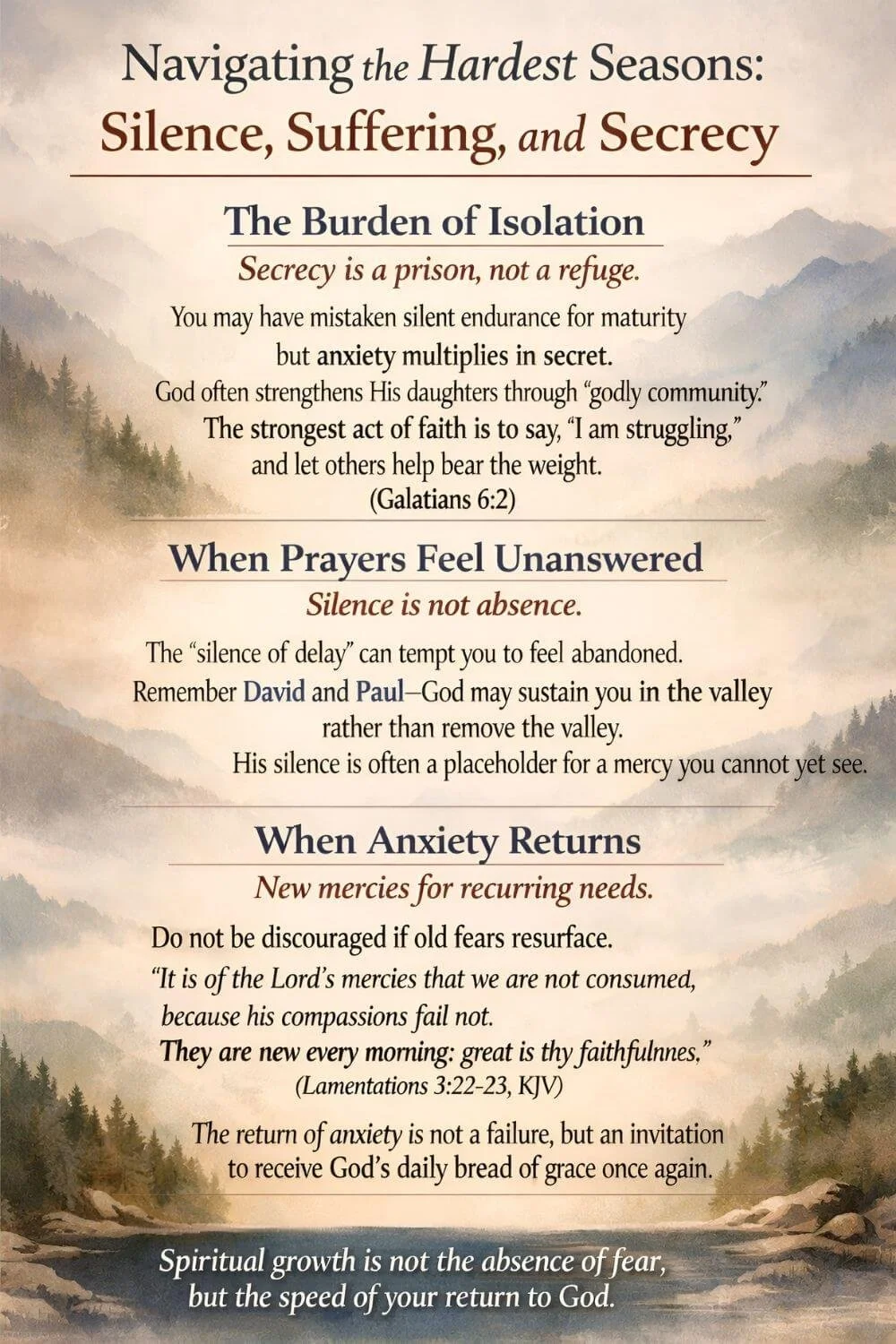
In deep seasons of distress, the enemy uses specific obstacles to make peace feel unattainable.
The Burden of Isolation Anxiety multiplies in secret. You may have mistaken silent endurance for maturity, but secrecy is a prison. God frequently strengthens His daughters through "godly community." The strongest act of faith is often the humility to say, "I am struggling," and allowing others to help bear the weight (Galatians 6:2).
When Prayers Feel Unanswered The "silence of delay" can tempt you to feel abandoned. Remember David and Paul; both knew the ache of a request that seemed ignored. But silence is not proof of absence. God may answer by sustaining you in the valley rather than removing the valley. His silence is often a placeholder for a mercy you cannot yet see.
When Anxiety Returns Do not be discouraged if old fears resurface. Because "new mercies" are promised every morning, we should expect recurring needs.
“It is of the Lord’s mercies that we are not consumed, because his compassions fail not. They are new every morning: great is thy faithfulness.” (Lamentations 3:22–23, KJV)
The return of anxiety is not a failure; it is an invitation to receive the "daily bread" of His grace once again. Spiritual growth is not measured by the total absence of fear, but by the increasing speed of your return to God.
7. Conclusion: Anchored in the Overcomer

The goal of this journey is not to achieve a perfectly untroubled life, but to become more deeply anchored in the One who never leaves. As you move from frantic control to active dependence, you will find that you are kept by the One who has already secured the victory.
“In the world ye shall have tribulation: but be of good cheer; I have overcome the world.” (John 16:33, KJV)
Reflection Questions
What are you gripping most tightly right now because surrender feels too vulnerable?
Which part of God’s character—His faithfulness, wisdom, mercy, or nearness—do you most need to lean on today?
What would it look like to measure your spiritual growth by the speed of your return to God, rather than the complete disappearance of fear?
🕊️ 🅹🅴🆂🆄🆂 🕊️
✗⚬メ𝟶,
Lilly
